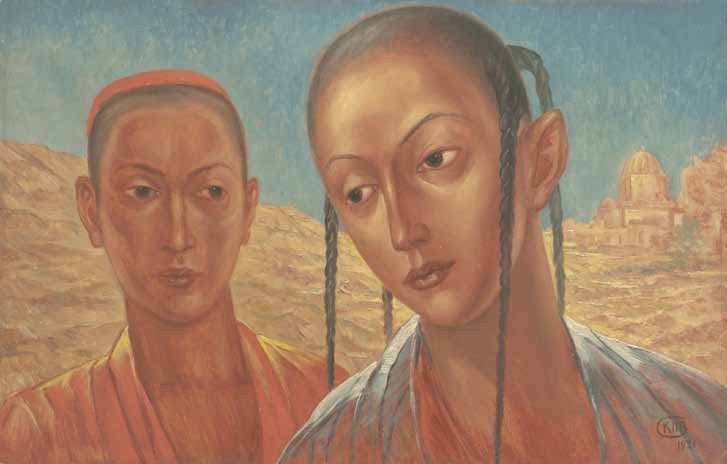
East Boy and Girl, 1921, 1921
Signed right lower corner in Cyrillic initials KPB in lined oval followed with date 1921 Expert reports: - Art historical analysis by Professor Dr. Mikhail Y. Guerman, International Association of Art Critics (AICA) at UNESCO, Russian Museum, Saint Petersburg, 2013 - Conservation and testing analysis carried out by Laurette Thomas laboratory, Paris, France, 4-5 June, 2013 - Conservation analysis and testing, Prof. Valery P. Golikov, PhD, chief of the department, Center of Historical and Traditional Technologies, Moscow, 18.03.2013 - Chemical - technological analysis carried out by research laboratory of State Art Museum of Finland Seppo Hornytzkyj, senior expert -concervator, Helsinki, Finland 14.12.2011 Provenance: - Since 1930s till 1992 Private collection Bersenev, Tallinn, Estonia . - 1992-2011 inherited by heirs, Vitaly Antonov and Irina Terguzheff-Antonov maiden name Bersenev, Helsinki – Stockholm. - 2011 – Shchukin Collection Paris – Tallinn. Notes: This works were created during his travels through Tashkent in May-June 1921. Exhibition: - October – December 2014, “In Other Worlds: The Art of the Russian Avant Garde 1910-1930”, New-York, Shchukin Gallery. Notes: Kuzma Petrov-Vodkin was a well-known Russian and Soviet painter and writer. His artistic personality was “universal.” He was interested and successful in many aspects of culture, from painting to literature and writing. Petrov-Vodkin was born into the lower middle-class family of a shoemaker. His first exposure to art was in his early childhood when he befriended a couple of icon painters and a freelance painter. After graduating from middle school, by chance, his mother’s employee invited well-known architect Roman Meltzer. Petrov-Vodkin was introduced to the guest and impressed him enough to get an invitation to study art in Saint Petersburg. His education was financed by a charity among local merchants. Petrov-Vodkin stayed in Saint Petersburg from 1895 to 1897 before transferring to the Moscow School of Painting, Sculpture, and Architecture. During his college years, Petrov-Vodkin happened to have a conflict with the Russian Orthodox Church, which took away his work on a chapel in Samara and ultimately destroyed it as an unacceptable work. Some of his early works were deemed too erotic. His first really well-known work was Dream (1910), which sparked a discussion among contemporary Russian artists. A main proponent of the painting was Alexander Benois and his main opponent, Ilya Repin (thus the painting was discussed by two major Russian painters of the time). Other major works of that time include Boys and, most notably, Bathing of a Red Horse. The latter became an instant classic and, in a way, a trademark for the artist and a conclusion to the period. During this stage in his artistic development, Petrov-Vodkin extensively used the aesthetic of the Orthodox icon combined with brighter colors and unusual compositions. During his earlier years (1912-1928), Petrov-Vodkin developed his “spherical perspective”: a unique twist that distorted the drawing in order to present the viewer high enough to actually notice the spherical curve of the globe. He used darker tones with time and his paintings became more detailed. He started painting still lifes and portraits, stepping further away from his previous themes. With help from the Soviet government, he made several trips across the Soviet Union, producing many works with didac- tic purposes. In his later years (1928-1937), Petrov-Vodkin became ill and had to abandon painting for several years. He turned to literature and