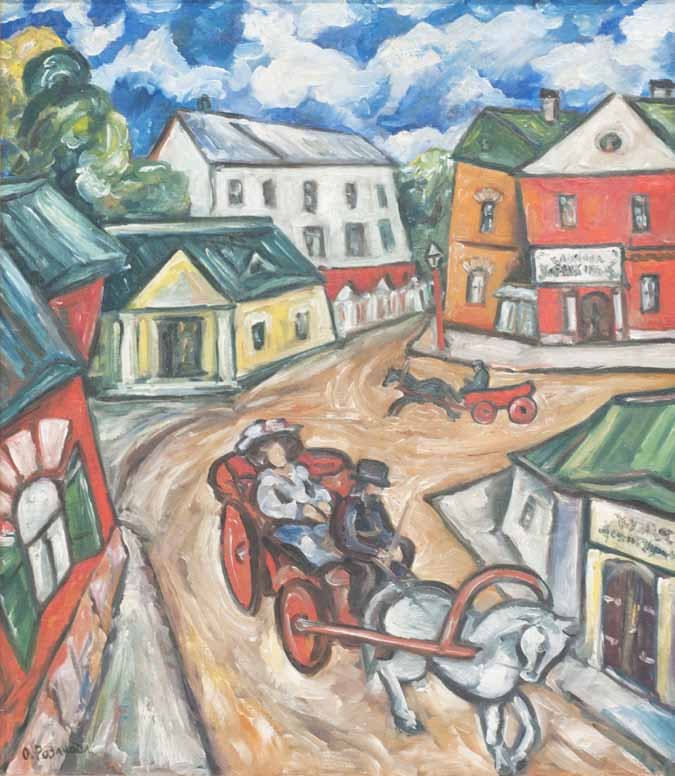
Town Landscape, June 1912, 1912
Signed in lower left corner in Cyrillic “O.Розанова” (O.Rosanova) Expertise: - Expert report of Cand. Sc. Vera N. Terekhina, leading specialist of the Institute of World Literature, the Russian Academy of Sci- ence; author of the definitive monograph for the creative work of Olga Rozanova, Moscow, 11/07/2006. - Expert report by the State Tertiakov Gallery, head of the department of scientific examination Lidia Gladkova, PhD, art historian Maria V. Valiajeva, Moscow, based on comparison and chemical-technological analysis, 28/10/2004. Notes: Rosanovas’s works City Landscape (or Landscape with Cabby) and Red House are kept in the Vitebsk Contemporary Museum, Vitebsk, Russia. The City Landscape, 1910 The Red House, 1910 The Work Smithy (Кузница) is kept in the Russian State Museum, Saint-Petersburg, Russia. The Smithy (Кузница), 1912 Exhibitions: - 2007: a private gallery in Vetoshny lane, Moscow - 2006: Estate Usovo “Seasons of Russian Aristocracy” Rublovskoie, Moscow district - 2004: Gallery in Kozitsky lane, National Art Collection Foundation “Russian Avant-Garde Art XX century”. Publications: - Catalogue to the exhibition “Seasons of Russian Aristocracy”, Moscow, 2006 Provenance: - By 1968: Vassily M. Shchukin Collection, Moscow (purchased from Galina Valdimirovna Kuibysheva) - 1998: inherited by Nikolay Shchukin, Shchukin Collection Paris – Tallinn Biography: Olga Vladimirovna Rozanova (21 June 1886–7 November 1918, Moscow) was a Russian avant-garde artist in the styles of Supre- matism, Neo-Primitivist and Cubo-Futurist. She was born to Melenki, a small town near Vladimir. In 1904 she attended art studios of Konstantion Yuon in Moscow. The same time she studied at the Stroganov School of Applied Art. In 1911 she became one of the most active members of the Soyuz Molodezhi (Union of the Youth). In 1912 Rozanova started a friendship with the Futurist poets Velimir Khlebnikov and Aleksey Kruchenykh, her future husband. In 1916 she married Kruchenykh and joined the group of Russian avant-garde artist Supremus that was led by Kazimir Malevich. By this time her paintings developed from the influences of Cubism and Italian Futurism, and took an entirely original departure into pure abstraction in which the composition is organized by the visual weight and relationship of colour. In the same year Rozanova together with other suprematist artists Kazimir Malevich, Aleksandra Ekster, Nina Genke, Liubov Popova, Ksenia Boguslavskaya, Nadezhda Udaltsova, Ivan Kliun, Ivan Puni and others) worked at the Verbovka Village Folk Centre. In 1917–1918 she created a series of non-objective paintings, which she called tsvetopis’ (shining). She died of diphtheria in 1918.