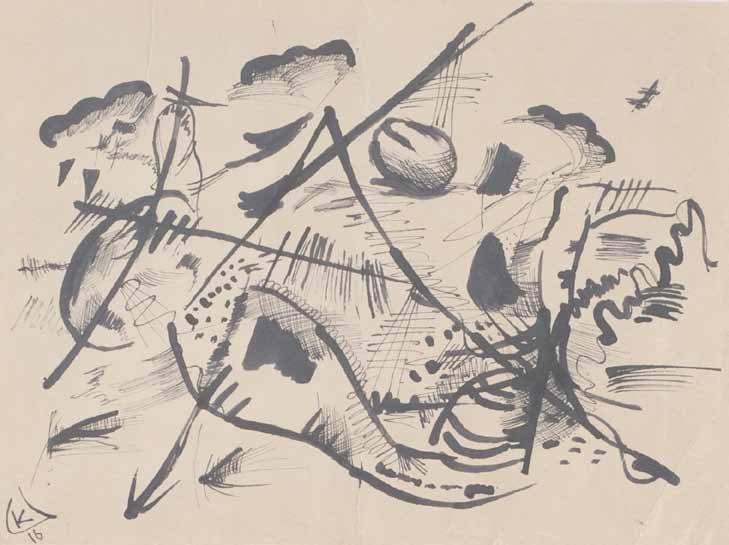
Abstraction, 1916, 1916
Signed in lower left cornet in Latin “K 16” Expert Reports: - Scientific and technological research and analysis by Prof. Victor P. Golikov, Department Chair, Center of Historical and Traditional Technologies of the Institute of Heritage named after Dmitry Likhachev, 2012 Moscow, Russia - Art and historical research by Prof. Viktor.S.Turchin, member of Russian Academy of Arts, professor at the Moscow State University Provenance: - 1910’s -1920’s acquired by Dmitry Petrovich Gordeev (archeologist, art historian, artist, specialist in East- ern art; born in Kharkov; lived and worked in Tbilisi 1910-1920; was very close to art circles and avant-garde artists of that time; chronicled the Tbilisi group of futurist artists; arrested in 1933; after release lived and worked in Tbilisi in the State Museum of Art in the Department of Russian art under the leadership of S. I. Natsubidze) - 1950s: acquired from above by the Natsubidze family, works were acquired as presents or purchased to sup- port Gordeev as he lived in hard conditions - 2012: acquired from the above by Private Collection, Paris-Tallinn Notes on Collections: Dmitry Petrovich Gordeev (1889 – 1968) was the son of the scientist and public figure P. A. Gordeev, his brother Bojidar was a poet. Gordeev was an archeologist, specialist in Caucasian and Byzantine, Middle Asian art; an artist, he was the student of F. I. Shmit, born in Kharkov. From 1910- 1920, he was close to the avant-garde literary and art circles in Moscow and joined the group of “Futurists” as a member. He became their chronicler (see his publication Tbilisi, 1918). He was arrested and judged during the artistic purges in autumn 1933, and later exiled to Tbilisi in 1943 where he worked as a research associate and later Chief of the Department of Russian Art at the museum in Tbilisi until 1979. Alexandra Vladimirovna Natsubidze was an employee of the Tbilisi Museum beginning in 1959 and from 1965 until her death led the department of Russian Art. Dmitry Petrovich Gordeev was her employee, from whom she purchased many works of the Russian Avant-Garde over the years to help support him financially.