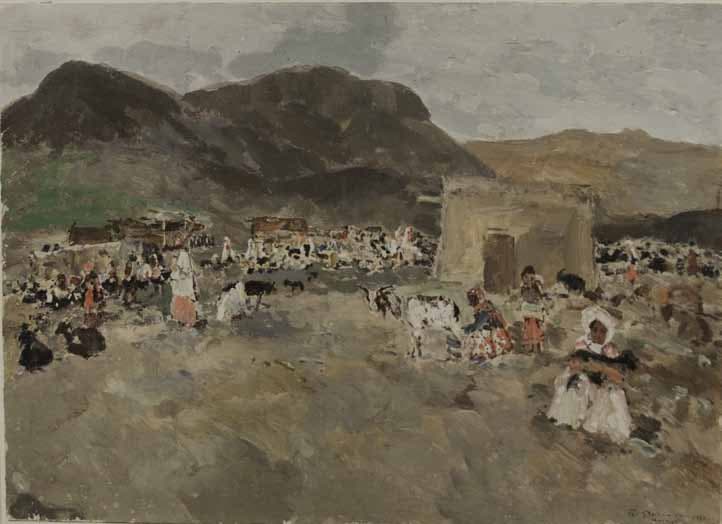
Turkmenia. Kurds in mountains. Village Firuza, 1936, 1936
Provenance: -Until 2012: part of collection in gallery “Euroart”, Moscow -Purchased from above by Nikolay Shchukin Collection, Paris-Tallinn. Exhibition: - May 19 – June 14, 2014: The National Arts Club, New- York, “From Primitivism to Propaganda: Russia’s Modern Masters. - July-August, 2014, “Summer show”, New York - September, 12 – November, 8, 2014, Paris, “Night life, stage life, and everyday life by Russia’s Modern Mas- ters. Notes: A member of the Association of Artists of Revolutionary Russia, he was a group of artists in the Soviet Union in 1928-1933. Diverse members of the group gained favor as the legitimate bearers of the Communist ideal to the world of art, formulating framework for the Socialist Realism style. Original founding members included Pavel Radimov (the last chairman of Peredvizhniki movement), Sergey Malyutin, Yevgeny Katzman, Pyotr Shukhmin and other realist painters, who had already established them- selves in artistic world before the Russian Revolution of 1917. The group formed within the Peredvizhniki movement, which held their last, 47th, public exhibition in 1922, and clearly placed itself in opposition to avant-garde art. Their first public statement as a new entity was a 1922 exhibition in Moscow; all proceeds were used for the relief of Russian famine of 1921. By 1928, the group sponsored 10 nationwide exhibitions with high publicity. Despite its revolutionary title, it successfully united artists of the “old school” like Abram Arkhipov, Aleksan- dr Makovsky, Nikolay Kasatkin, Konstantin Yuon and younger ones like Sergei Gerasimov and Isaak Brodsky. In a decade, it grew from 80 to over 300 members. Broad membership and the dominance of mature artists